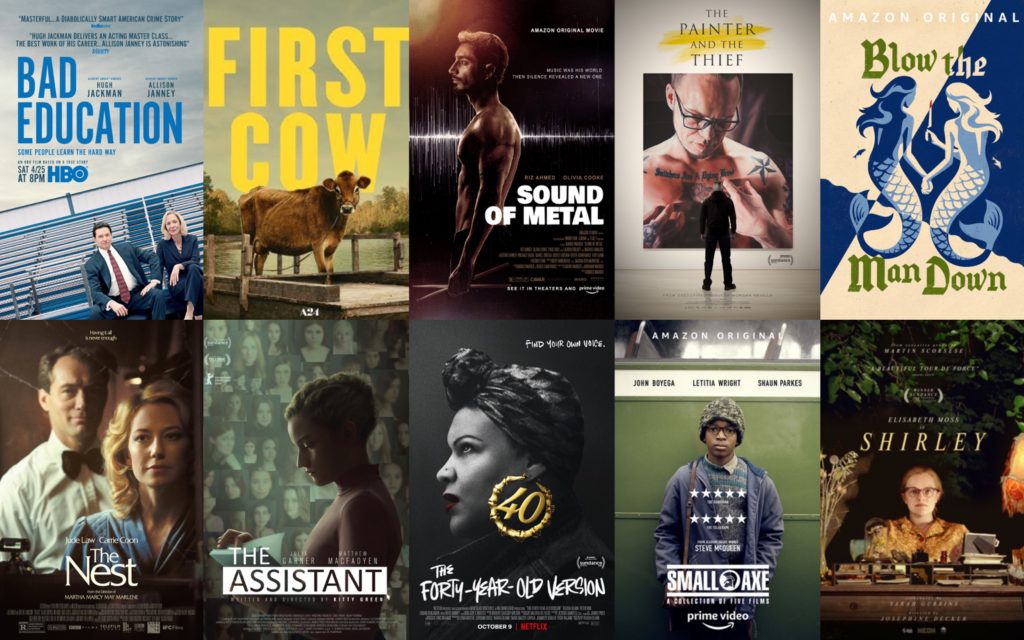
For the first time in my adult life, I didn’t see my favorite movie of the year in a theater.
For the first time since I could afford to see movies on my own, not one movie in my top ten list was seen in a theatrical setting. For the first time since I recognized the unique pleasure of watching a movie in a dark room, on an oversized screen, I can count on one hand the number of movies of the past year to give me that pleasure.
 That’s just how it was for cinephiles in 2020. What began as a year of promise and anticipation—plenty of new films from beloved directors and franchises, ample time to track down hidden gems to evangelize before their weeklong theatrical engagement expired, riding the high that was the most significant Academy Award win in a generation—I looked forward to continuing my lifelong hobby of going to the movies.
Until I didn’t.
There are plenty of thinkers, writers, and industry insiders with smarter insights on how COVID-19 altered the movie industry, perhaps irreversibly, and accelerated the apparent shift away from theaters as the default moviegoing experience. I will try my best not to parrot here whatever compelling theory most recently entered my ears concerning the film industry. And I’ll try not to eulogize theater-going too much. If the last year has taught me anything about my favorite pastime, it’s that I am incapable of predicting what my moviegoing experience will look like in the next year.
 I’ll of course look forward to my first opportunity to see a movie once again in a theatrical setting; while I love the movies in my top ten, I can’t help but wonder how differently my list might look if I’d had a chance to see as many of the 99 movies I saw in 2020 as possible on a big screen. I wonder which movies would have fared better in my estimation at my local arthouse. I wonder which movies, though placed on my Best of the Year list here, would otherwise have fallen on the wrong side of the line dividing film from television. But in a year where seemingly all rules have been cast aside, I’m struck by how little I care about these lines.
Because, no matter what, how I engaged my favorite pastime changed drastically in 2020. And the best I can do—better than holding on to increasingly arbitrary rules, waxing sentimental about the ideal moviegoing experience, or lamenting what might have been—is to cast all that aside, and pay tribute to the cinematic art that moved me most this year, regardless of screen size.
Movies I’ve Yet to See:
|
|
The Runners-Up
(#11 – #26)
 And Then We Danced (dir. Levan Akin) — This story of a gay man desperate to become a dancer in conservative Georgia doubles as a closeted gay romance and as an elegant examination of how restrictive powers stifle personal expression. I love how frankly this movie examines jealousy and failure. A gentler, bittersweet answer to Black Swan. (Prime)
Boys State (dir. Jesse Moss & Amanda McBaine) — A compelling and occasionally unnerving documentary about a Texas mock government program meant to teach young men about government and politics. Moss and McBaine find wonderful subjects, each of whom might succeed in government someday. A meaningful exploration of just how easily—and just how soon—core political truisms get seeded in us. (Apple+) Da 5 Bloods (dir. Spike Lee) — If the mealy politics of BlacKkKlansman disappointed me slightly, then the latest Spike Lee Joint is a most welcome return to form. Playing out in some ways a tense, Hustonesque treasure-hunting adventure, it is also a critique of America’s treatment of black people in Vietnam—before, during, and after—told with Lee’s characteristic righteousness and didacticism. Delroy Lindo gives one of the year’s best performances. (Netflix)
Deerskin (dir. Quentin Dupieux) — An irresistibly perverse movie about a man murderously obsessed with a peculiar deerskin jacket. Featuring Jean Dujardin at his most comically disheveled and disgruntled. Adèle Haenel gets the chance to star in something a bit more playful than I’m used to seeing. This could be a satirical indictment on toxic masculinity. But mostly I just like how it’s about a guy with a deerskin jacket being all murdery and stuff. (HBO Max)
Emma. (dir. Autumn de Wilde) — I am fortunate the last movie I saw in theaters before the world caught ablaze was one this lavishly produced, this gorgeously shot, and this plainly entertaining. A mirthful comedy of etiquette and protocol, mannered in all the right ways, and none of the wrong ways. Anya Taylor-Joy deserves only the best career. (HBO Max) Dick Johnson is Dead (dir. Kristen Johnson) — A memoir as clever as it is queasy, Johnson documents her father in the early stages of his dementia, using cinematic trickery to concoct more outlandish scenarios of his imminent death (i.e. falling down stairs, getting smashed by a plummeting air-conditioner). An inventive, cathartic, unsettling pre-mortem about a man who means a whole lot. (Netflix)
Farewell Amor (dir. Ekwa Msangi) — A sensitive, considered triptych of an Angolan immigrant family, newly reunited after almost two decades apart, adjusting to a new life together in East Flatbush. Msangi brilliantly demonstrates the power of empathy and perspective, showing how a person’s attitudes—though they seem comical or cruel—often stem from someplace sincere and real. A beautifully structured feat of humanism. (Digital Rental)
His House (dir. Remi Weekes) — A triumph of striking set design and expressive filmmaking, Weekes’ feature debut about a Sudanese refugee couple, haunted in their new home by a menacing spirit, is a harrowing thriller and a potent examination of guilt and tragedy. The year’s best horror film. (Netflix)
I’m Thinking of Ending Things (dir. Charlie Kaufman) — What starts as a seemingly straightforward relationship dramedy quickly loses all pretense of realism, devolving into something navel-gazing, fatalistic, interminable, obtuse, baffling… and incontrovertibly the product of its writer-director. A fascinating and maddening portrait of pent-up, unresolved regret and self-disappointment. It’s an unpleasant film, but unpleasant by design. (Netflix) Lingua Franca (dir. Isabel Sandoval) — A personal, exquisitely shot, and truly auspicious debut from Sandoval, who also stars as Olivia, an undocumented trans woman seeking a green card marriage. As she provides elder care to a third-generation Russian-American family—often under fear of apprehension—Sandoval advocates gently (yet firmly) for a more humanizing lens of understanding immigration. (Netflix)
Never Rarely Sometimes Always (dir. Eliza Hittman) — Sometimes the best way to condemn injustice is simply to follow one story, and allow it to speak for itself. Hittman follows a teenager who must travel discreetly from rural Pennsylvania to NYC to procure abortion services; depicting every legal, financial, and logistical barrier she could plausibly face. An absorbing, frustrating procedural-of-sorts, bolstered by a more unaffected style than expected from the director of Beach Rats. (HBO Max)
One Night in Miami… (dir. Regina King) — The best of the year’s many stage-to-screen adaptations, using real-life civil rights titans to illuminate some of the era’s most vital internal (and eternal) debates. King may not be reinventing film language with her feature debut, but her assured skill with ensemble and location suggests this essential actor has promise to be an essential director. (Prime) Palm Springs (dir. Max Barbakow) —I am astonished all over again how filmmakers continue to milk the Groundhog Day gimmick in ways that don’t just succeed, but feel genuinely rich. This comedy about mid-thirty depressives doomed to repeat the same destination wedding day is an involving romantic comedy about mutual self-improvement and self-forgiveness, and proof Cristin Milloti should be in every movie henceforth. (Hulu)
Small Axe (dir. Steve McQueen) — Arguably the year’s most rewarding and illuminating cinematic project, regardless of whether it’s film or television (a debate, incidentally, that I find more distracting than helpful). McQueen’s five-part anthology welcomes viewers into London’s West Indian community of the 1960’s-1980’s, and into that community’s people, their joys, and their travails. As a celebration of culture and history, it feels rich and subtle in ways I don’t always expect from McQueen. More on one of these installments, further down this list. (Prime)
Soul (dir. Pete Docter & Kemp Powers) — Even if it’s not quite the masterwork on par with the Pixar of yesteryear, it is a visually adventurous and delightfully well-imagined exploration of passion and vocation. Doctor and Powers (the latter having a killer year, between this and One Night in Miami…) impressively avoid the kind of tidy theme-work even their studio’s best films can’t resist. Abstractly, gently profound. (Disney+)
Time (dir. Garrett Bradley) — I’m a sucker for docs like this, where a narrative is captured in ways that feel elliptical yet fluid. This collection of footage from Fox Rich struggling over decades to free her husband from prison will demand sympathy regardless of its aesthetic presentation. But Bradley assembles it in a way that feels like a constructed memory; a tribute to the Rich family as they strive for the day where they can begin to make up for lost time. (Prime)
The Best Movies of 2020

10) Shirley (dir. Josephine Decker)
Literary adaptations have a tendency of working best when it is the spirit—not the letter—that gets transposed from page to frame. In that more spiritual sense, Decker adapts Shirley Jackson arguably more faithfully than any other filmmaker, even though Shirley is not actually an adaptation of any of her works. Its depiction of the Lottery and We Have Always Lived in a Castle author’s tumultuous marriage to critic Stanley E. Hyman serves as a fictionalized backdrop for a newly married couple, entering the Jackson/Hyman home as summer guests, which eventually devolves into some hellish, months-long reprisal of Virginia Woolf. The cast—Logan Lehrman, Michael Stuhlbarg, and Odessa Young—enliven this intergenerational ensemble superbly. But as the ensemble’s centerpiece, Elizabeth Moss sharpens her natural attunement to prickly and standoffish characters, capturing Jackson’s pained brilliance without a trace of sentimentality. She and Decker turn Shirley into a barbed yet sumptuous expression about the pains and promises of creative life.
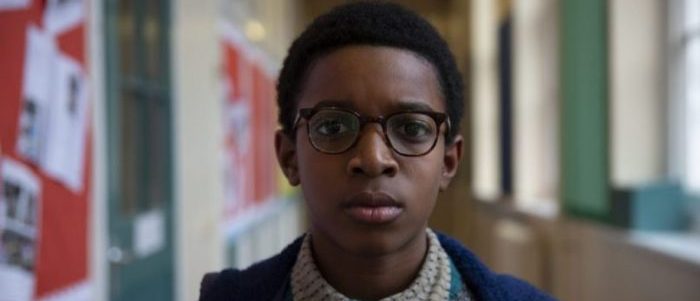
9) Education (dir. Steve McQueen)
As I suggested earlier with my runners-up, McQueen’s Small Axe anthology considers the history and culture of London’s West Indian community’s—his own community—with celebration. That celebration can be literal, as it is in Lovers Rock’s hourlong dance party. It can be ambivalent, as it is in Mangrove or Red, White and Blue’s depictions of racist law enforcement from streets to court. It can be an ode, as when Alex Wheatle sings praise to music and the written word.
Education, the conclusion of the anthology and my personal favorite, celebrates a community that evangelizes its members’ inherent value when few else care to. Shot in grainy 16mm with a snug aspect ratio—an aesthetic choice giving the movie an ingeniously strictured intimacy—the camera follows a bright and passionate 12-year-old named Kingsley, whose brightness gets dimmed when his school system sends him to a “special needs” school for tellingly dubious reasons. Of course Education means to critique a racist education system that can’t even manage subtlety as it pushes black and immigrant communities to society’s margins. Lesser movies would dwell on this, or on the precipitating anguish of Kingsley and his family. And though those elements certainly aren’t absent, the film’s beating heart—a group of in-community activists committed to exposing systemic injustice, gathering resources to restore Kingsley’s education and spirit—transforms Education into a gracious (yet always sober) depiction of a community invested not merely in its own survival, but in its own vitality. It is, to use a word, a celebration.
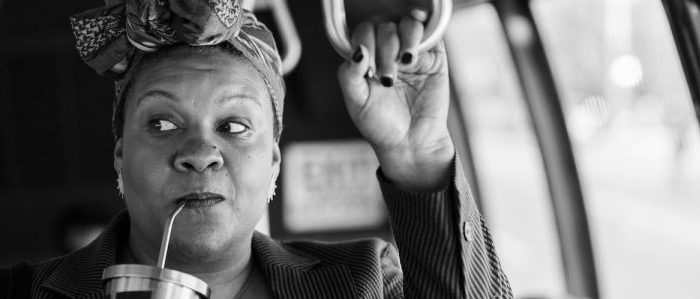
8) The Forty-Year-Old Version (dir. Radha Blank)
To achieve success is a daunting enough task. How torturous must it be, then, to have to fulfill the promise of success? For struggling playwright Radha, a protagonist certainly inspired by her namesake writer/director, success is more than an unfulfilled ambition. A decade removed from her designation by Time Out New York as a “Thirty under 30” talent to watch, success looms over her with an increasingly cruel gaze. What started as a promise is now withered into burden. And under that burden is a dwindling youth and embers of non-production.
Foremost a study of how success eludes Radha, Blank is impressively extensive in her reach. As a black woman selling her art in a market powered by the money of white men, her reluctance to calibrate her work to their tastes factors strongly, and understandably. And while that conflict provides the greater narrative thrust, Blank skillfully adds every unflattering facet of Radha’s self into the calculus, addressing the mystery of her stubbornly unrealized ambitions by considering factors as much inside her realm of control as outside. Radha is held back by distorted expectation as much as she is held back by her doubt and uncertainty. And most remarkably of all, Blank conveys all of Radha with biting wit and humor, sharpening this film’s sincerity. This is the comedy of the year.
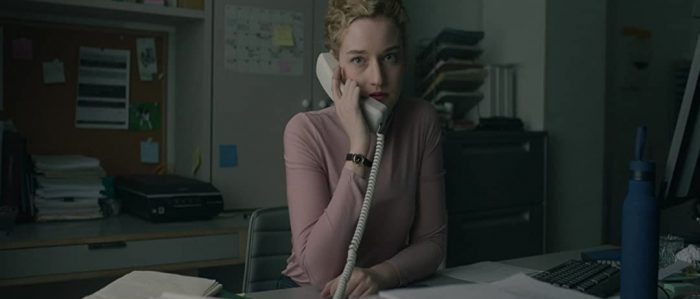
7) The Assistant (dir. Kitty Green)
Occasionally we can recognize history taking place on a single day. But more often than not the impact of a single day eludes the broad mindset required to shape the greater narratives we tell ourselves—be it the trajectory of our life or career, an establishment of historical circumstances, or a long-simmering social reckoning. The Assistant’s runtime spans but a single work day, from the perspective of a young intern named Jane as she observes the queasy politics in the office of an unseen, Weinsteinesque movie producer.
The movie’s relationship to the #MeToo reckoning thus couldn’t be clearer. Yet as sweeping as that movement has proven, Green’s own sweep stays shrewdly focused on Jane. By keeping a close eye on Jane as she goes about her well-polished routine—and by considering the factors informing Jane’s personal response to her boss’ suspect behavior—Green depicts a character both pressured and incentivised to keep her head down. It examines her decision to commit to her routine for the promise of a view less bleak and grey than the cubicle walls in front of her. This makes The Assistant’s brilliantly controlled vision less broadly about a historical moment than about one brick in the dam that movement would go on to crack.
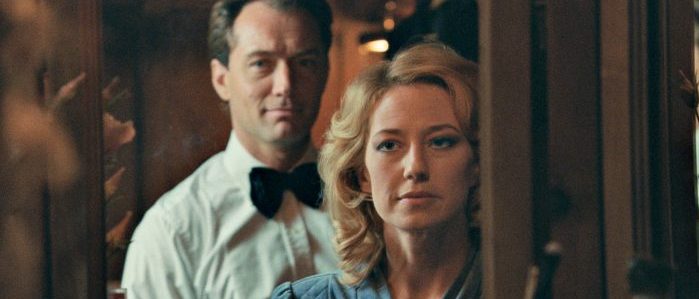
6) The Nest (dir. Sean Durkin)
With an ominous tone, smothering bleakness, and a deadpan visual wit, Sean Durkin’s decade-in-waiting follow-up to his superb Martha Marcy May Marlene is one of the cleverest haunted house movies in years. Or rather, it is so long as your definition of “haunted” is generous.
The horrors befalling the O’Hara family—whose ambitious patriarch, played by Jude Law, uproots them and brings them overseas to some creaky, oversized estate in rural England—prove more circumstantial than spectral. And as life on the homestead grows grim, particularly for Carrie Coon’s character as she learns how financially calamitous it was to put faith in her husband’s decisions, the house itself seems to change everyone. Reagan’s America and Thatcher’s UK sit deliberately in the backdrop. It inflates Law’s delusions of economic prosperity as he tries to make deals happen in London while his family stays cooped up at home. What is, exactly, poisoning this particular family proves opaque, perhaps too opaque for some. But as an examination of tone, a consideration of family, and as a showcase for Law and Coon’s biting performances, The Nest suggests the scariest kinds of hauntings are those you can’t readily identify.
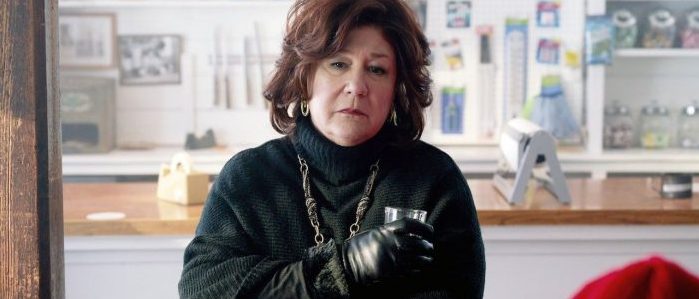
5) Blow the Man Down (dir. Danielle Krudy & Bridget Savage Cole)
A potent, efficient small-town crime saga, told with the wry folksiness of the Coens and the deep-rooted familiarity of Bogdanovich. It’s a marvel how much character and history Krudy and Cole sear into the ninety minutes of their feature breakthrough. What begins initially as a story between the Connolly sisters, young women mourning their newly deceased mother and grappling with her estate, shifts into a sudden and scrambled effort to cover up an accidental murder. That murder ripples across the modest crime network of the modest Maine fishing village.
Blow the Man Down’s charm leans heavily on its production design, which elegantly presents the more provincial qualities of the village under which the Connollys, for their own reasons, struggle. The film’s richness depends on the village population, and how the cast illuminates a history that, for good and ill, binds the villagers together. Sophie Lowe and Morgan Saylor do a fine job as the sisters, but the movie really comes alive as we learn more about the village matriarchy—pitting June Squibb against a magnificent Margo Martindale—whose shaky but generations-spanning alliance seems ready to crumble. Blow the Man Down is the best kind of crime story, one that doesn’t so much revel in the crime itself, but illustrates how crime and vice inform how people find ways to live next to one another as harmoniously, if tenuously, as possible.

4) The Painter and the Thief (dir. Benjamin Ree)
I expect one reason we see so much art about the relationship between the artist and their subject, particularly in nonfiction, is it’s the kind of relationship in which many artists invest the most thought and time. As much as that can read like abstract, artistic navel-gazing to those whose relationship to art is more concerned about enjoying it than producing it, it does remain a valuable topic. Seeing as the artist by nature of their work must manipulate or exploit a subject to suit the artistic vision they present to the world. To some degree, agency gets taken.
In this remarkable documentary about a painter named Barbora wishing to make as her next subject Karl, the recovering addict who while high helped to steal one of her paintings, Benjamin Ree never shies from the strangeness of that artist/subject relationship. Even as the two form what feels like a sincere bond—even friendship—the question of what the artist is getting out from her subject never quite dissipates. Ree structures his movie magnificently, giving equal weight in his film to the subject himself, and his bumpy, nonlinear path to recovery. And through that restoration of sorts of his agency, we begin to understand how much he values being the subject of an artist; as someone worth being seen. The first time Karl sees his likeness through Barbora’s work… well, I wouldn’t want to spoil it for you. It’s the kind of extraordinary moment only documentary can capture, and it’s part of why this is the year’s most moving work of nonfiction.
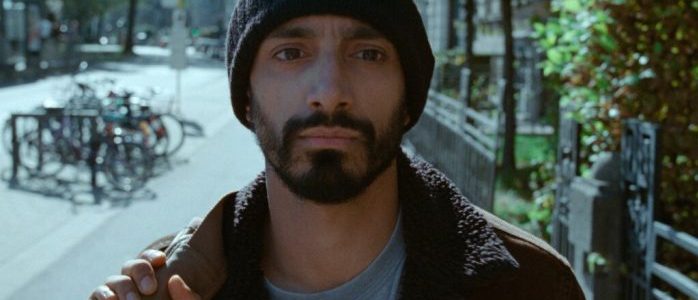
3) Sound of Metal (dir. Darius Marder)
Its triumphs in sound design and performance have been well-documented by other critics. But what makes Sound of Metal’s story about Ruben, a drummer working gig-to-gig with his girlfriend Lou before suddenly losing his ability to hear, a truly exceptional movie about disability is its resistance to shortcuts. While keeping true to Ruben’s anxieties about what going deaf does to his identity as a musician, Marder walks a tonal tightrope. He studiously avoids wallowing and von Trier-style miserablism, while also finding a narrative framework that avoids the facile condescension of blander “overcoming adversity” flicks.
Guiding his study of Ruben is the stunning lead performance from Riz Ahmed, who accesses Ruben’s desire to undo this life change with a depth going far beyond simply wanting to hear again. Ruben, who is in recovery and who clearly values order and structure to maintain sobriety, sees restoration of order as his prime directive. And how that need to “restore” triggers a response in him very true to the Ruben we come to know transforms Sound of Metal into a movie not merely about disability, but about the personal ways we respond to complication. That it explores complication so honestly and unsentimentally makes this feature debut truly special.
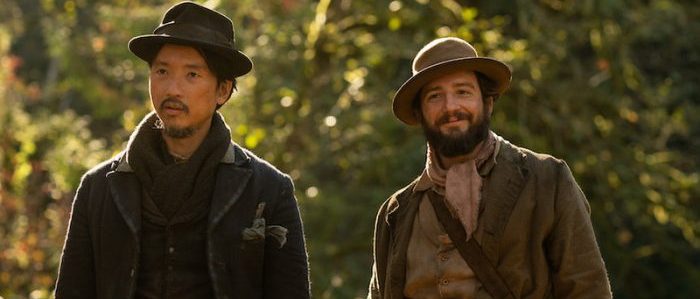
2) First Cow (dir. Kelly Reichardt)
With each successive film she releases, I’ve come to expect quite a bit from Kelly Reichardt. I expect immaculate compositions, deceptively plainspoken narratives, quiet performances that demand the viewer’s active engagement with her characters. First Cow fulfills those expectations, as dutifully and artfully as can be expected. Yet with this story of a modest yet talented cook bonding with a Chinese immigrant to carve out a living among fur trappers in the Pacific Northwest, Reichardt offers something I’m not sure she’s given me before; certainly not to this degree. She gives warmth. In its own gentle, sweethearted fashion, Reichardt punctures even her own baseline conception of the frontier west as just some bleak, unforgiving terrain. Watching Cookie and King-Lu succeed in their simple enterprise of selling buttermilk biscuits to grizzled traders, achieving that modest living together proves satisfying to watch. It helps that John Magaro and Orion Lee sport such strong chemistry as two partners whose camaraderie is borne both from mutual need and their well-complemented talents. I could watch Cookie and King-Lu peddle their biscuits across several movies, MCU-style.
Yet for all the warmth portrayed onscreen, at no point does First Cow feel toothless. Motivated by survival and profit, complications arise as King-Lu’s business ambitions take over. And the source of those biscuits’ dairy ingredient—the eponymous first cow or Oregon—isn’t exactly attained by legal means. Valuable and enduring questions arise in this film about the deception of industry, the dignity of labor, and the myth of being self-made. And if bleakness momentarily subsides for Cookie and King-Lu, from the prologue Reichardt means for us to understand their industriousness will come to an undesirable end. And even if we never know precisely how that end comes, the mystery charges First Cow warmth with a portent. Stunningly, this choice doesn’t actually negate the movie’s warmth; it clarifies just how precious it can be, particularly in America’s bleakest and most unforgiving terrains.
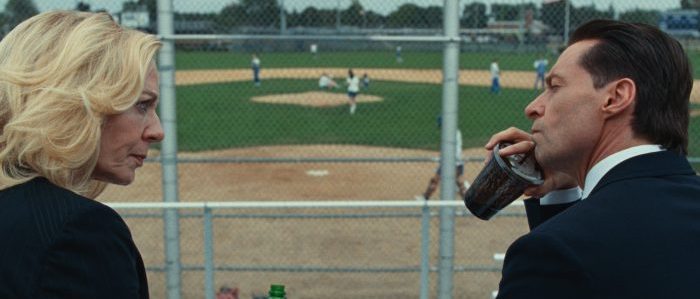
1) Bad Education (dir. Corey Finley)
Presentation is everything.
Presentation can raise bad fiction into literary canon, and can drive lemons off the lot. It attracts investors to even the most unprofitable venture. It instills trust in even the flimsiest institutions. It elevates resumes from the slush pile with a simple Ivy League name-drop. It quells suspicion if it convincingly assures prosperity. It allows administrators in a wealthy Long Island school district to siphon millions in taxpayer dollars for their own personal luxuries. Presentation, for all the falseness it can obscure, means everything.
Certainly it means everything to Frank Tassone, one especially larcenous administrator, for whom presentation fills his wardrobe with expensive suits in lieu of orange jumpsuits. And Bad Education, Corey Finley’s assured and bleakly funny depiction of Tassone’s role in the 2002 Roslyn Schools financial scandal, brilliantly examines presentation as both a falsity and as a necessity. It makes no excuse for the criminality of Tassone or his conspirator, Pam Gluckin. But what separates his movie from the “based on a remarkable true story” chaff is its ability to apply those criminals’ greed and sense of entitlement right back onto the school system being leeched off of—a school system that values presentation every bit as highly as its top administrators.
As the movie progresses, and as Frank and Pam’s crimes get gradually uncovered, Frank attempts to re-seal the lid by arguing what this district stands to lose in the exposure: prestige. Trust. Tax revenue. The ability to assure their students a future their parents can be pleased with. It’s a convincing argument. And so Bad Education becomes a story about sustaining the pretense of greatness… until it becomes unsustainable.
For all Finley’s bitterness about how easily we relinquish our trust to a well-coiffed face, it’s in his ensemble that we can find the humanity innate to such deceptions. Hugh Jackman, giving arguably his finest performance ever, approaches Frank not as a sinner nor even as a saint, but as a veteran of public service who feels such successful service has entitled him to the luxuries he’s assured for a generation of learners. It is a performance driven by entitlement, an emotion precious few of us can credibly claim never to have felt. And though it’s easy and fun and justified to deride the wealth and entitlement of the system depicted in Bad Education, its human pulse reminds us just how tenuous our most revered institutions truly are: education, decency, democracy. What happens to these when the they’re presented to us begins to crumble?